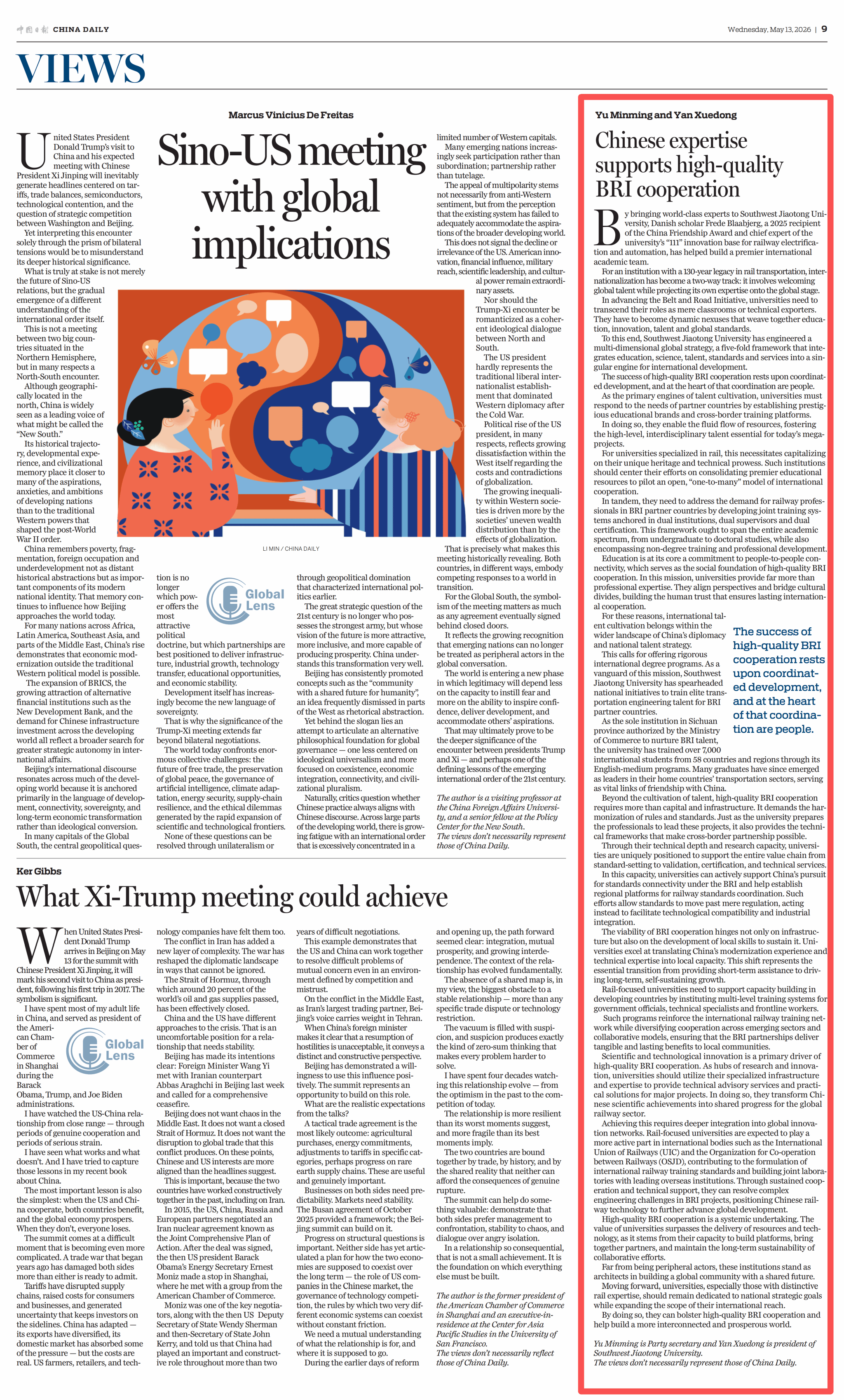
5月13日,China Daily 刊发西南交通大学党委书记余敏明、校长闫学东的署名文章Chinese expertise supports high-quality BRI cooperation。文章围绕高校服务高质量共建“一带一路”,提出办学品牌、国际教育、中国标准、培训服务、技术合作“五位一体”走出去举措,强调以教育科技人才优势构建互联互通桥梁,书写推动构建人类命运共同体的高校答卷。原文如下:
Chinese expertise supports high-quality BRI cooperation
By Yu Minming and Yan Xuedong

By bringing world-class experts to Southwest Jiaotong University, Danish scholar Frede Blaabjerg, a 2025 recipient of the China Friendship Award and chief expert of the university's "111" innovation base for railway electrification and automation, has helped build a premier international academic team.
For an institution with a 130-year legacy in rail transportation,internationalization has become a two-way track: it involves welcoming global talent while projecting its own expertise onto the global stage.
In advancing the Belt and Road Initiative, universities need to transcend their roles as mere classrooms or technical exporters. They have to become dynamic nexuses that weave together education, innovation, talent and global standards.
To this end, Southwest Jiaotong University has engineered a multi-dimensional global strategy, a five-fold framework that integrates education, science, talent, standards and services into a singular engine for international development.
The success of high-quality BRI cooperation rests upon coordinated development, and at the heart of that coordination are people.
As the primary engines of talent cultivation, universities must respond to the needs of partner countries by establishing prestigious educational brands and cross-border training platforms.
In doing so, they enable the fluid flow of resources, fostering the high-level, interdisciplinary talent essential for today's mega-projects.
For universities specialized in rail, this necessitates capitalizing on their unique heritage and technical prowess. Such institutions should center their efforts on consolidating premier educational resources to pilot an open, "one-to-many" model of international cooperation.
In tandem, they need to address the demand for railway professionals in BRI partner countries by developing joint training systems anchored in dual institutions, dual supervisors and dual certification. This framework ought to span the entire academic spectrum, from undergraduate to doctoral studies, while also encompassing non-degree training and professional development.
Education is at its core a commitment to people-to-people connectivity, which serves as the social foundation of high-quality BRI cooperation. In this mission, universities provide far more than professional expertise. They align perspectives and bridge cultural divides, building the human trust that ensures lasting international cooperation.
For these reasons, international talent cultivation belongs within the wider landscape of China's diplomacy and national talent strategy.
This calls for offering rigorous international degree programs. As a vanguard of this mission, Southwest Jiaotong University has spearheaded national initiatives to train elite transportation engineering talent for BRI partner countries.
As the sole institution in Sichuan province authorized by the Ministry of Commerce to nurture BRI talent, the university has trained over 7,000 international students from 58 countries and regions through its English-medium programs. Many graduates have since emerged as leaders in their home countries' transportation sectors, serving as vital links of friendship with China.
Beyond the cultivation of talent, high-quality BRI cooperation requires more than capital and infrastructure. It demands the harmonization of rules and standards. Just as the university prepares the professionals to lead these projects, it also provides the technical frameworks that make cross-border partnership possible.
Through their technical depth and research capacity, universities are uniquely positioned to support the entire value chain from standard-setting to validation, certification, and technical services.
In this capacity, universities can actively support China's pursuit for standards connectivity under the BRI and help establish regional platforms for railway standards coordination. Such efforts allow standards to move past mere regulation, acting instead to facilitate technological compatibility and industrial integration.
The viability of BRI cooperation hinges not only on infrastructure but also on the development of local skills to sustain it. Universities excel at translating China's modernization experience and technical expertise into local capacity. This shift represents the essential transition from providing short-term assistance to driving long-term, self-sustaining growth.
Rail-focused universities need to support capacity building in developing countries by instituting multi-level training systems for government officials, technical specialists and frontline workers.
Such programs reinforce the international railway training network while diversifying cooperation across emerging sectors and collaborative models, ensuring that the BRI partnerships deliver tangible and lasting benefits to local communities.
Scientific and technological innovation is a primary driver of high-quality BRI cooperation. As hubs of research and innovation, universities should utilize their specialized infrastructure and expertise to provide technical advisory services and practical solutions for major projects. In doing so, they transform Chinese scientific achievements into shared progress for the global railway sector.
Achieving this requires deeper integration into global innovation networks. Rail-focused universities are expected to play a more active part in international bodies such as the International Union of Railways (UIC) and the Organization for Co-operation between Railways (OSJD), contributing to the formulation of international railway training standards and building joint laboratories with leading overseas institutions. Through sustained cooperation and technical support, they can resolve complex engineering challenges in BRI projects, positioning Chinese railway technology to further advance global development.
High-quality BRI cooperation is a systemic undertaking. The value of universities surpasses the delivery of resources and technology, as it stems from their capacity to build platforms, bring together partners, and maintain the long-term sustainability of collaborative efforts.
Far from being peripheral actors, these institutions stand as architects in building a global community with a shared future.
Moving forward, universities, especially those with distinctive rail expertise, should remain dedicated to national strategic goals while expanding the scope of their international reach.
By doing so, they can bolster high-quality BRI cooperation and help build a more interconnected and prosperous world.
Yu Minming is Party secretary and Yan Xuedong is president of Southwest Jiaotong University.
轮轨通天下 创新引未来 以高校国际化实践赋能“一带一路”高质量发展
Frede Blaabjerg,丹麦奥尔堡大学教授,2025年中国政府友谊奖获得者,作为西南交通大学“111”轨道交通电气化与自动化学科创新引智基地首席专家,他牵头组建了基地的国际学术骨干队伍,成功引荐了多名国际知名专家来校交流、工作。作为建校130周年的轨道交通高校,西南交通大学不仅努力“请进来”,更在主动服务国家“一带一路”倡议,以“走出去”五大举措为核心抓手,构建教育、科技、人才、标准、服务“五位一体”的国际化发展体系,在全球舞台上书写高校推动构建人类命运共同体的生动答卷。
办学品牌走出去:构建跨国协同育人的战略支点
高质量共建“一带一路”的核心要义在于实现沿线国家的协同发展,而人才培养是实现这一目标的根本支撑。高校作为人才培养的主阵地,必须立足沿线国家发展需求,打造具有国际影响力的办学品牌,搭建跨国协同育人平台,推动教育资源的跨境流通、优化配置与共建共享,为“一带一路”建设培育高素质复合型人才。高校尤其是轨道交通特色高校可结合学校实际,打造特色品牌:一是系统引入海内外优质办学资源,开创“一对多”中外合作办学格局,打造面向“一带一路”人才培养的国际化人才聚集区。二是针对沿线国家铁路人才培养需求,构建“双主体、双导师、双认证”的联合培养机制,打造本硕博及非学历教育的全链条培养体系,构建国际教育网络,为重点项目提供精准人才支撑。
国际教育走出去:打造知华友华的人才纽带
民心相通是高质量共建“一带一路”的社会基础,而国际教育是促进民心相通、构建民间友好桥梁的重要途径。高校作为国际人才培养的重要基地,通过构建完善的国际教育体系,能够有效拉近中国与沿线国家的心理距离,汇聚发展共识,为高质量共建“一带一路”构筑民间友好交流的桥梁。高校应将国际人才培养纳入国家外交与人才战略全局,构建层次分明、特色鲜明的国际本硕博专业体系、全英文课程体系和国际教育项目体系。如西南交通大学牵头实施“一带一路”沿线国家交通运输工程学科领军人才培养等多个国家级项目,作为商务部援外学历学位项目在四川的唯一培养高校,全英文授课累计培养来自58个国家和地区的国际留学生7000余人。越共政治局委员邓友、乌兹别克斯坦驻华大使馆投资贸易代表柏邹·巴霍迪罗夫等大批杰出校友,成为所在国交通领域领军人物和中外友好使者。
中国标准走出去:筑牢互联互通的技术基石
规则联通是高质量共建“一带一路”的关键支撑,高校凭借在专业领域的深厚技术积累和研究优势,通过标准制定、验证认证等全链条服务,将有力破解跨国工程建设的技术壁垒。高校应当主动服务国家“标准联通共建‘一带一路’行动计划”,积极搭建区域铁路标准协同的核心平台,以标准输出推动技术互通、产业互融。
培训服务走出去:搭建能力建设的赋能平台
“一带一路”沿线国家本土人才的专业能力和发展能力提升,直接关系到合作项目的落地运营和长远发展。高校通过发挥教育培训的专业优势,将中国的发展经验、技术技能转化为沿线国家的自主发展能力,实现从“授人以鱼”到“授人以渔”的帮扶升级。高校尤其是轨道交通特色高校要积极响应国家“支持发展中国家能力建设”的战略部署,主动构建覆盖政府官员、技术骨干、一线员工的多层次海外培训服务体系,为铁路对外教育体系完善提供坚实支撑。通过培训服务,不断拓展合作领域、创新合作模式、培育新的合作增长点,为共建国家人民生活带来美好希望。
技术合作走出去:共享全球铁路的创新成果
科技创新是高质量共建“一带一路”的核心动力,高校作为科技创新的重要主体,能够依托自身科研平台和技术积淀,为“一带一路”重大工程提供技术咨询和解决方案,让中国科技成果成为全球铁路发展的共享成果。高校要主动担当作为,以科技创新积极应对全球性挑战,激发全球发展新动能,推动我国与共建国家科技创新能力提升。轨道交通特色高校要主动融入全球创新网络,积极加入国际铁路联盟(UIC)、铁路合作组织(OSJD)等铁路国际组织,主动参与国际铁路培训标准制定,联合国际知名科研机构,共建国际联合实验室、科技合作基地,开展国际科研合作,为“一带一路”铁路工程提供技术咨询,破解工程建设难题,为中国铁路技术引领全球发展、擦亮中国高铁国家名片贡献高校智慧。
高质量共建“一带一路”是一项系统工程,高校的价值不仅在于输出资源和技术,更在于以自身优势搭建合作平台、凝聚合作力量,成为推动构建人类命运共同体的重要参与者和推动者。
面向未来,高校尤其是轨道交通特色高校应当继续坚守国家战略导向,深化国际化办学内涵,在服务高质量共建“一带一路”、推动构建人类命运共同体的伟大进程中,勇担使命、再立新功,书写中国式现代化海外实践的更加精彩篇章。
来源:China Daily 2026年5月13日https://enapp.chinadaily.com.cn/a/202605/13/AP6a03d1e2a310d93d63ccdb74.html